Gardener Crystal Palace: Recycling and Sustainable Gardening Practices
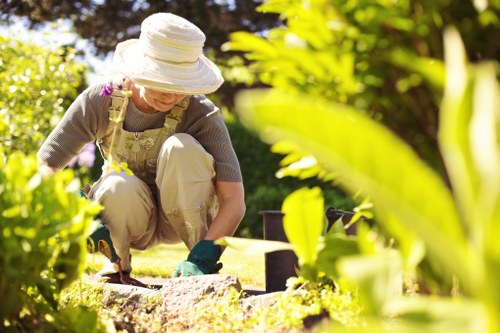
Welcome to our sustainability page from Gardener Crystal Palace, where we outline how a Crystal Palace gardener can create an eco-friendly waste disposal area and maintain a sustainable rubbish gardening area. Our approach balances practical on-site waste separation with borough-level recycling schemes. We prioritise reducing landfill, increasing composting of green waste, and ensuring that organic and inorganic materials are diverted to the right local facilities. In line with London-area waste policy, we adopt separate streams for food waste, garden waste and dry recycling in every job we undertake.Our commitment is to set measurable targets and to work with residents and local organisations. We aim for a clear, achievable recycling target that drives operational choices and procurement of low-emission vehicles. The following sections provide details on targets, transfer stations, partnerships, vehicle choices and on-site best practice for gardeners working in Crystal Palace and neighbouring boroughs.
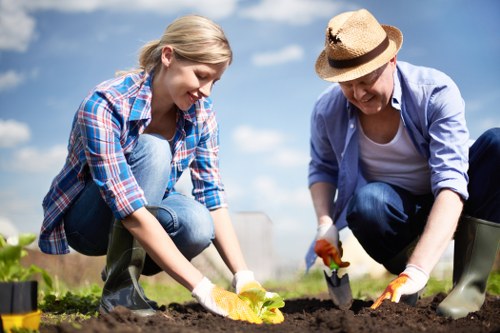 Many boroughs in South London run a three-stream approach to household waste separation — typically dry recycling, food waste and garden/green waste. As a Gardener in Crystal Palace, we mirror that approach on-site by segregating soil-contaminated waste, healthy green cuttings, woody prunings and recyclables like plastic pots and metal plant supports. This reduces cross-contamination and increases the proportion of material accepted at municipal facilities.
Recycling percentage target and how we measure it
We have set a bold target: increase our site-level recycling to 75% by 2028 for all garden-related waste streams (wood chip, compostable material, plastics, metals and paper/card). This target is ambitious for a local gardening service but achievable with a consistent separation process, regular staff training and partnerships with local reuse networks. Progress is measured quarterly by weight and volume diverted from landfill and recorded in our sustainability log.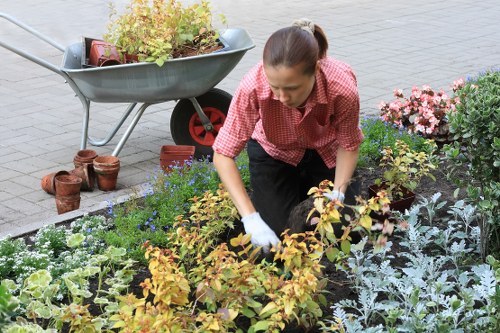 On-site procedures include colour-coded bins for green waste, food-soiled material and dry recyclables, plus secure containers for contaminated soil pending testing. We use clearly labelled containers and provide brief induction for new staff to ensure segregation is consistent. Our team of Crystal Palace gardeners follows a standard protocol: reduce at source, reuse materials where safe and recycle the rest through approved channels.
To support the target we operate an internal audit system and report key metrics: diverted tonnes, compost produced on-site, and items passed to reuse partners. We also track fuel- and transport-related emissions associated with waste removal to ensure our carts and vans remain low-carbon.
Local transfer stations and waste handling
We work with several nearby municipal and private transfer stations to accept separated loads from gardening sites. Typical local facilities include borough recycling points and household waste recycling centres (HWRCS) in the wider South London area, with convenient access routes from Crystal Palace. Where possible we consolidate loads to minimise vehicle trips. Examples of services we connect with are borough-run recycling centres in neighbouring boroughs and licensed transfer stations that accept green waste for composting.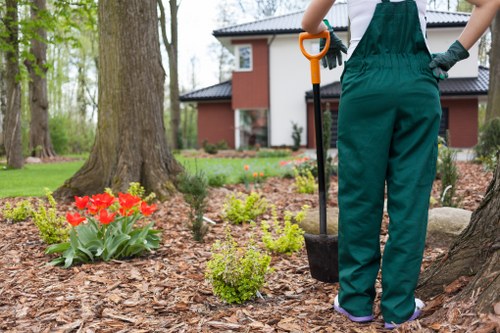 Partnerships with charities and reuse organisations are central to our strategy. We partner with local reuse charities and community projects to donate usable items such as paving slabs, planters and surplus topsoil. These partnerships help create a circular approach: unwanted but reusable materials become resources for community green spaces, allotments and school gardens. We collaborate with social enterprises specialising in upcycling garden furniture and garden tool libraries to extend the life of useful items.
 Transport is a significant part of the footprint for any gardening operation. To keep emissions low we use a mixed fleet: electric vans for short urban trips, Euro 6 hybrids for longer moves and cargo e-bikes for small local deliveries and waste runs. Our low-carbon vans carry segregated loads to transfer stations or collection points, and we plan routes to maximise payload efficiency and minimise empty return trips. We also use local consolidation hubs where multiple small loads can be combined for a single transfer trip.
Operational highlights and community actions include:
- On-site composting: converting green waste into usable compost forclients' gardens;
- Material reuse: donating salvageable planters and paving to community groups;
- Responsible disposal: transporting contaminated or hazardous garden wastes to licensed transfer stations;
- Education: promoting borough-level separation norms such as kerbside food waste and garden waste collections where relevant;
- Low-emission transport: prioritising electric and hybrid vans, and cargo bikes for inner-Crystal Palace work.
As a Crystal Palace gardener operating sustainably, we encourage clients to adopt small changes that make a big difference: separate containers for green waste, avoid plastic-heavy packaging for plant supplies, and choose durable, repairable garden products. We also offer seasonal clean-ups that prioritise reuse and composting over landfill disposal.
Implementing a practical, repeatable eco-friendly waste disposal area at each site reduces costs and the environmental footprint. For larger projects we provide a waste-management plan that maps material flows to local transfer stations, outlines scheduled pickups to avoid double handling, and identifies items suitable for charity donation or community reuse.
Our promise: to reduce waste, increase recycling and operate a sustainable rubbish gardening area that aligns with borough policies on waste separation. By setting a 75% recycling target, partnering with local transfer stations and charities, and using low-carbon vans, Gardener Crystal Palace is committed to practical, measurable sustainability in every job.